> For the complete documentation index, see [llms.txt](https://docs.crosscurve.fi/llms.txt). Markdown versions of documentation pages are available by appending `.md` to page URLs; this page is available as [Markdown](https://docs.crosscurve.fi/crosscurve-metalayer-1/what-is-crosscurve-metalayer/crosscurve-consensus-bridge.md).
# CrossCurve Consensus bridge
The **CrossCurve Consensus Bridge** addresses one of the key problems of modern cross-chain solutions — the vulnerability of bridges and the so-called “**black swan**” risk. A prime example of such a risk is the **Multichain** incident, after which **Curve DAO** withdrew its trust from bridges based on centralized governance.
The core issue lies in the fact that most existing bridges are controlled by a limited group of participants — validators or members of multisig groups. This makes them vulnerable and unstable. Classic examples of such failures include hacks or loss of funds in protocols such as **Multichain**, **PolyNetwork**, **Wormhole**, **Nomad** and **Ronin**.
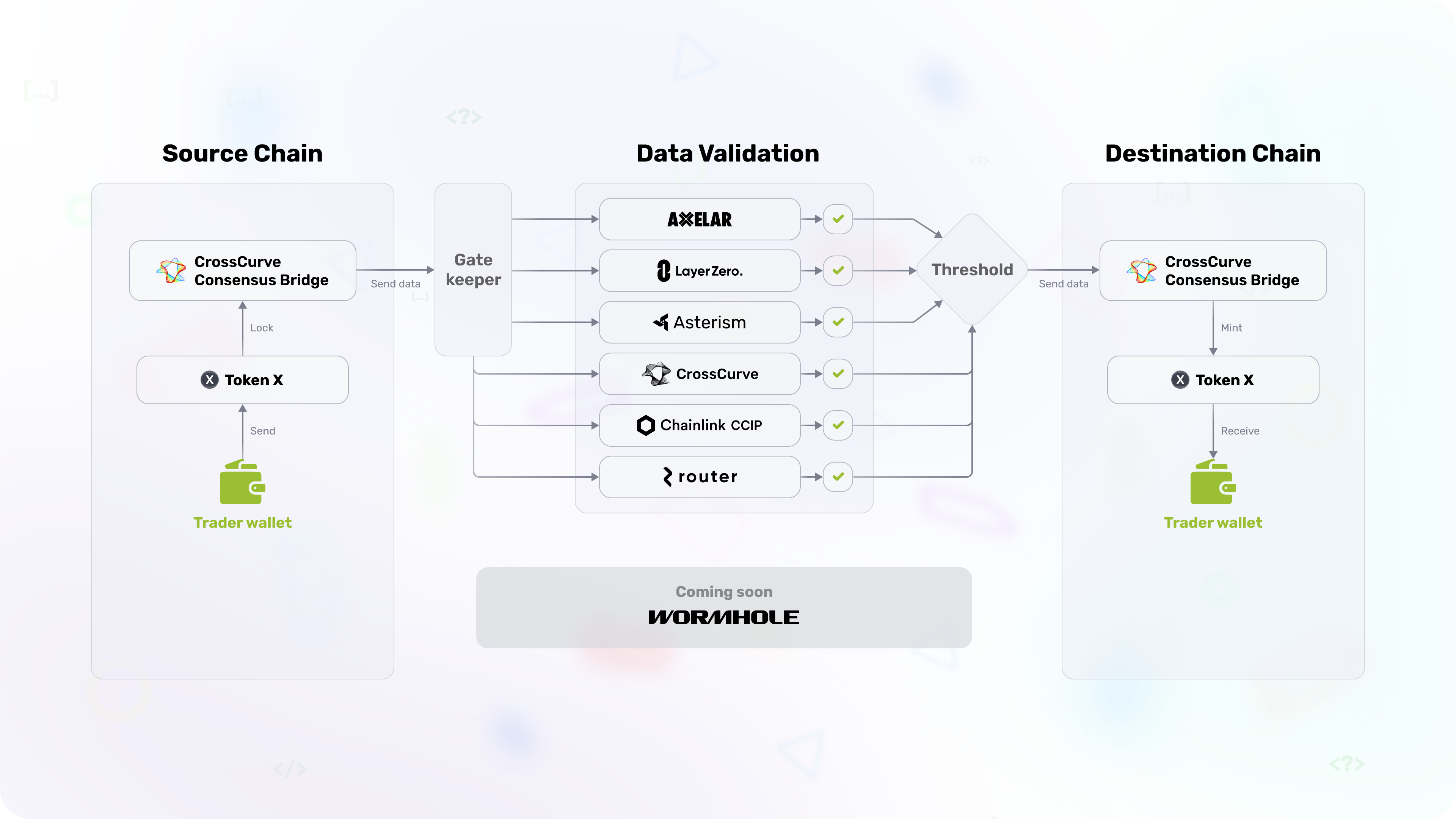
Unlike the traditional **PoA** (proof-of-authority) solutions, the **CrossCurve Consensus Bridge** uses a validation model based on agreement between independent data transmission protocols. This architecture involves **Axelar**, **LayerZero**, **Router Protocol**, **Asterizm** and **Chainlink CCIP**. A transaction is completed only if consensus is reached among multiple sources. If the data diverges, the transaction is automatically rejected, preventing potential compromise and ensuring the safety of user funds.
### How it works:
* The user's assets are locked in the consensus bridge smart contract on the source network.
* Transaction data is transmitted through multiple protocols simultaneously, and the smart contract of the target network verifies their consistency.
* If consensus is reached, the transaction is finalized; otherwise, the funds are returned to the user.
### Advantages:
* **Security**: The risk of compromise is minimized thanks to consensus among several protocols — the likelihood of all protocols being hacked at the same time is virtually zero.
* **Decentralization**: Bridge security does not depend on individual teams; the bridge smart contracts are governed by **CrossCurve DAO**, and the protocol’s liquidity is fully controlled by users.
* **Versatility**: The consensus bridge supports the transmission of both tokens and data, making it a universal tool for cross-chain applications.
**Consensus Bridge** is not just a bridge—it is the transport layer of the **CrossCurve Metalayer**, providing a reliable connection between blockchains. It enables developers and users to safely transfer assets, data, and liquidity, forming the foundation for a scalable and resilient cross-chain ecosystem of the future.
---
# Agent Instructions
This documentation is published with GitBook. GitBook is the documentation platform designed so that both humans and AI agents can read, navigate, and reason over technical content effectively. Learn more at gitbook.com.
## Querying This Documentation
If you need additional information that is not directly available in this page, you can query the documentation by asking a question.
Perform an HTTP GET request on the following URL with the `ask` and `goal` query parameters:
```
GET https://docs.crosscurve.fi/crosscurve-metalayer-1/what-is-crosscurve-metalayer/crosscurve-consensus-bridge.md?ask=&goal=
```
`ask` is the immediate question: it should be specific, self-contained, and written in natural language.
`goal` is what the user is ultimately trying to achieve, the reason they need the answer. Sharing it helps GitBook give you a better, more relevant answer. A goal is most helpful when it describes the outcome the user wants rather than restating the question. For example, with `ask=how do I create an API token`, a goal like `automate deployments from our CI pipeline` lets GitBook tailor the answer to that use case.
The response will contain a direct answer to the question and relevant excerpts and sources from the documentation.
Use this mechanism when the answer is not explicitly present in the current page, you need clarification or additional context, or you want to retrieve related documentation sections.