> For the complete documentation index, see [llms.txt](https://docs.crosscurve.fi/llms.txt). Markdown versions of documentation pages are available by appending `.md` to page URLs; this page is available as [Markdown](https://docs.crosscurve.fi/crosscurve-metalayer-1/copy-of-what-is-crosscurve-metalayer.md).
# Copy of What is CrossCurve MetaLayer
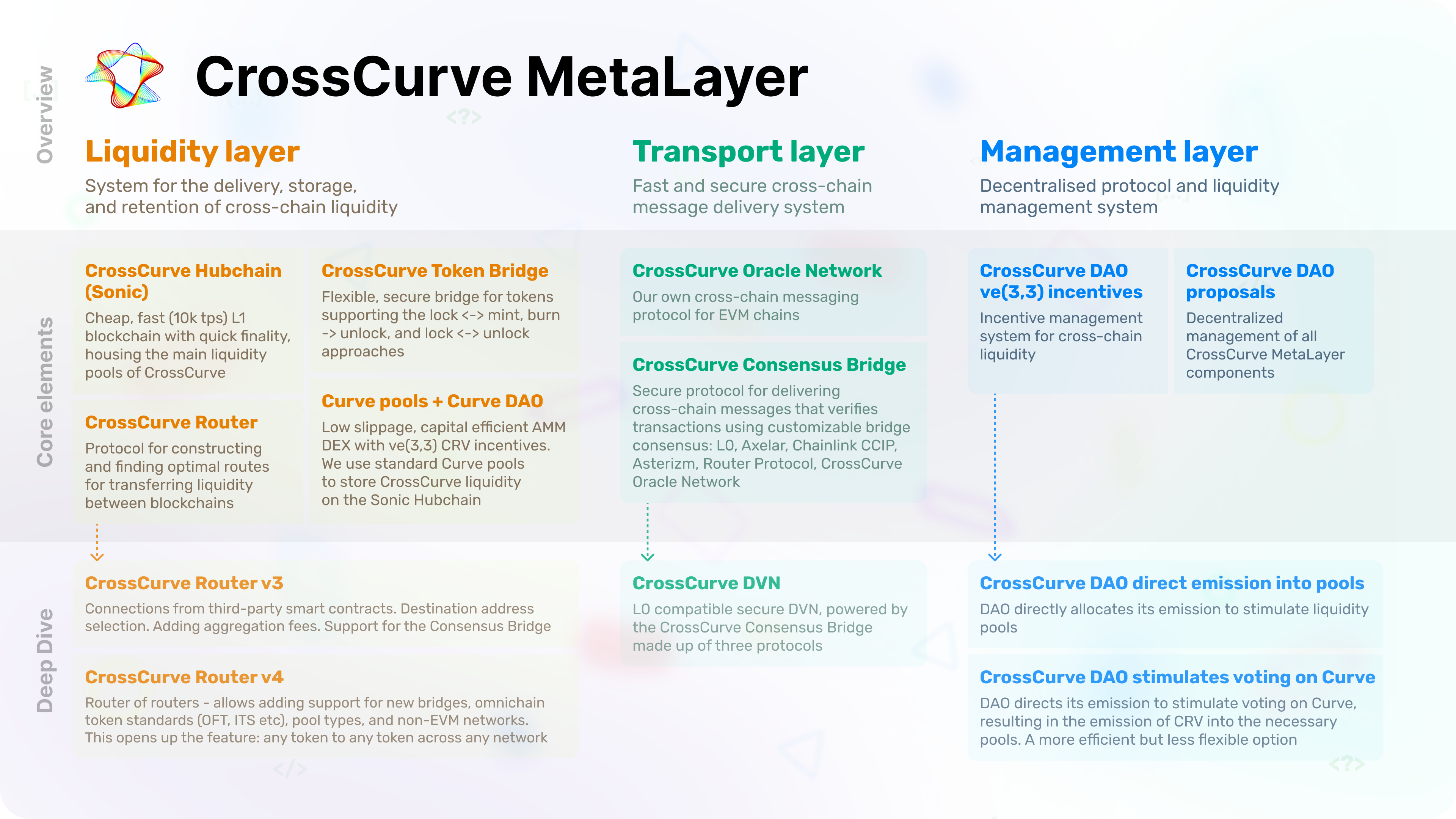
**CrossCurve MetaLayer** is a unified decentralized infrastructure for cross-chain liquidity and incentives, powered by the **Curve AMM**. It enables efficient swaps, yield generation, and access to deep **DeFi** liquidity secured by the **Consensus Bridge**.
## MetaLayer Architecture
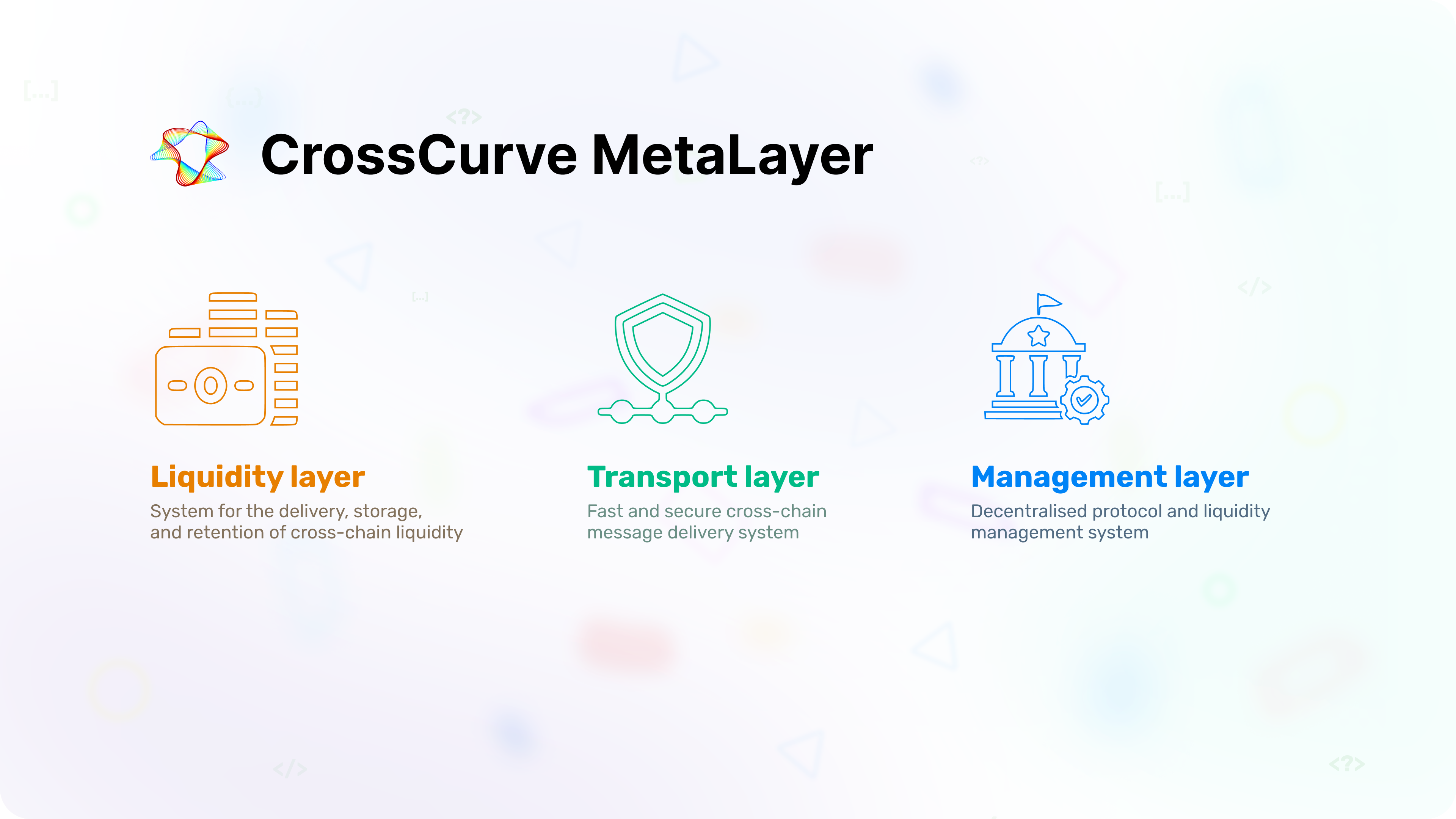
**CrossCurve MetaLayer** emerged as a logical extension of the decentralized **EYWA bridge**. A simple “**bridge**” is no longer sufficient—more advanced solutions are required for real **DeFi** use. Reliability and efficiency are the two key requirements for modern cross-chain services. **MetaLayer** was created to meet these demands through a modular architecture that includes three interconnected layers:
### 1. Transport Layer — Consensus Bridge
This layer is responsible for securely transferring liquidity between blockchains. The **Consensus Bridge** simultaneously uses several trusted protocols (such as **Axelar**, **LayerZero**, **Wormhole**), significantly reducing the risk of attacks.
### 2.Liquidity Layer
This layer addresses several critical functions:
* **Efficient liquidity use**. In traditional models, liquidity must be reserved for each blockchain pair, leading to exponential cost growth. In **MetaLayer**, all liquidity is concentrated in the Sonic hub-chain and shared through **Curve Stable Pools**. This reduces the liquidity requirement from 2N²−N to 2N, delivering up to \~49.5x efficiency gains when supporting 50 blockchains.
* On-chain swaps. **Curve AMM** algorithms enable automatic asset exchanges based on liquidity distribution. If liquidity is lower in a certain direction, slippage increases—everything remains fair and transparent.
* **Secure storage**. **Curve** pools are audited and manage over $2 billion in TVL— this represents proven security and user trust.
### 3. Management Layer — CrossCurve DAO
Decentralized governance is not just a slogan—it is the foundation of **MetaLayer**’s operation. All key decisions are made by **DAO** participant a through voting. This eliminates centralization risks. Additionally, the **ve(3,3)** tokenomics model allows incentives to be directed toward the most active and profitable areas. More activity means more rewards, which attracts more liquidity and makes swaps even more beneficial.
***
## Why Decentralization Matters
**CrossCurve MetaLayer** is a decentralized protocol for managing cross-chain liquidity. Unlike intent-based protocols, where core logic runs off-chain and requires complex configurations, **MetaLayer** stays true to **DeFi** principles. Anyone can become a liquidity provider and earn–no high entry barriers or reliance on centralized intermediaries.
.png?alt=media&token=316d4717-d32f-4c4f-a612-11e57bbf19ba)
.png?alt=media&token=9f0a1ccc-7a85-43eb-93d4-24f88bfecee4)
.png?alt=media&token=a7c66b8d-9769-4ee3-9c91-9d1e031f0b73)